History
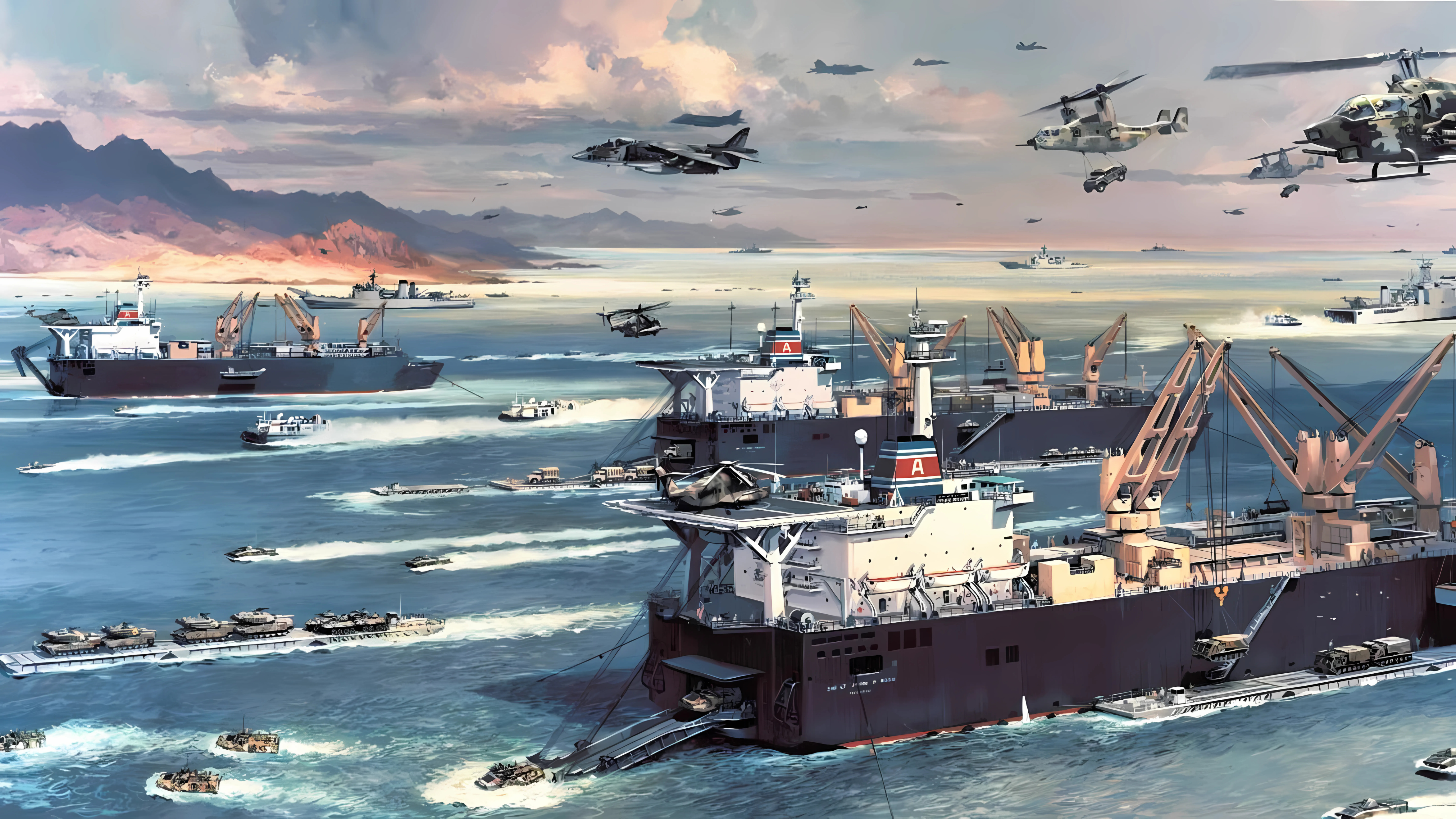
The Marine Corps' forward-positioned sustainment enterprise emerged in the late 1970s as the nation sought to project combat capability without lengthy strategic buildup. Following President Jimmy Carter's 1977 directive establishing the Rapid Deployment Joint Task Force, the Marine Corps began developing a capability that positioned equipment closer to potential operating areas, reducing reliance on strategic lift and accelerating response options for geographic combatant commanders.
By 1979, Marine Corps equipment and supplies were being loaded aboard Military Sealift Command ships, establishing the foundation of the Maritime Prepositioning Force. In 1981, the first Maritime Prepositioning Force ships became operational, supported by sustainment nodes at Diego Garcia, Okinawa and Subic Bay. That same year, the United States and Norway signed an agreement to position equipment for the reinforcement of Norway. The resulting Norway Air-Landed Marine Expeditionary Brigade achieved operational capability in 1990, leveraging climate-controlled cave complexes to preserve equipment for rapid employment in extreme cold-weather environments.
The strategic value of forward-positioned sustainment was demonstrated during Operations Desert Shield and Desert Storm. The 7th Marine Expeditionary Brigade rapidly established combat capability in Saudi Arabia using equipment already in theater, validating the concept's ability to generate combat capability at speed while reducing demand on strategic transportation networks. Throughout the 1990s and early 2000s, the enterprise supported crisis response, humanitarian assistance and combat operations, including Fiery Vigil, Restore Hope and Iraqi Freedom.
Established Sept. 1, 1989, Blount Island Command became the Marine Corps' central organization for generating, sustaining, modernizing and distributing forward-positioned combat capability. Its growth paralleled the evolution of the enterprise. In 1986, the Marine Corps leased 262 acres of Blount Island from Gate Maritime Properties to support maritime positioning operations. As the mission expanded, the installation grew to more than 1,000 acres through acquisition in 2004, and the Marine Corps evolved its sustainment model beyond maritime positioning.
A significant transformation occurred in 2005. Under the U.S.-Kuwait Defense Cooperation Agreement, the Marine Air-Ground Task Force Augmentation Program–Kuwait was established to provide Marine expeditionary units with forward-positioned equipment maintained ashore for operational employment. Managed by Blount Island Command, MAP-K sustained approximately 1,500 principal end items supporting Operations Enduring Freedom, Iraqi Freedom, New Dawn and Inherent Resolve. The program demonstrated how ashore sustainment nodes could complement maritime positioning capabilities during long-duration contingency operations.
Also in 2005, the Norway program was restructured and renamed the Marine Corps Prepositioning Program–Norway. Guided by a commandant-directed review, it evolved into a balanced Marine air-ground task force capability. Today, MCPP-N includes a shore-based infantry battalion task force, aviation support equipment and specialized cold-weather systems. It remains a critical component of deterrence and crisis response in Europe and a key node within the global positioning network.
 On Nov. 21, 2006, Marine Corps Support Facility Blount Island was activated under Marine Corps Installations East, providing the infrastructure required to sustain the Marine Corps' expanding global positioning mission.
As defense strategy evolved and Force Design emphasized distributed operations, survivability and forward persistence, the Marine Corps adapted its sustainment architecture accordingly. MAP-K concluded in 2022, reflecting a transition toward more agile, globally distributed sustainment models. MCPP-N remained an essential component of this architecture while emerging concepts increasingly emphasized integrated afloat and ashore sustainment, strategic flexibility and rapid employment across contested environments.
Today, Blount Island Command operationalizes integrated global sustainment across the Marine Corps' global positioning network. Drawing on decades of experience in maritime positioning, theater sustainment and allied partnerships, the command synchronizes maintenance, modernization, distribution and regeneration of service-managed equipment positioned worldwide. Through disciplined lifecycle management, enterprise asset visibility and operational integration, it ensures forward-positioned equipment remains maintained, configured and ready for rapid employment by Marine, joint and combined forces.
 Marine Corps Support Facility Blount Island provides the secure, resilient infrastructure that underwrites this mission. The installation supports maritime positioning ship operations, industrial maintenance, logistics integration and sustainment activities that enable global responsiveness. Every 42 months, ships undergo scheduled maintenance periods during which Blount Island teams inspect, repair, modernize and reconfigure equipment to align with current and future force requirements.
From Maritime Prepositioning Force squadrons and Norway's cave complexes to today's globally integrated positioning network, the enterprise has continually evolved to meet emerging operational demands. Together, Blount Island Command and Marine Corps Support Facility Blount Island transform sustainment capacity into positioned combat capability, providing Marine forces the operational reach and strategic flexibility required to campaign, respond and prevail worldwide.